Diocese of Hereford Multi-Academy Trust
Our Family of Academies

Our Family of Academies

GoodrichChurch of England Primary School

Curriculum
Achieve
Philippians 4:13 (International Children’s Bible)
‘I can do all things through Christ because he gives me strength.’
At Goodrich Church of England Primary School, we work as a school community to share knowledge, skills and understanding required now and for the future to help each individual achieve their potential. The school provides an academic, physical, emotional, social, and safe environment supported by Christian values, where children are supported to engage in their learning through a broad and well-balanced curriculum so that they become confident, independent and resilient learners.
Believe
Matthew 5:14 (Good News)
‘You are like light for the whole world.’
We believe that each individual should be given the opportunity to gain an understanding of themselves both personally and spiritually within an environment that embraces difference. Members of the school community are encouraged to consider their thoughts and actions as people of the wider world.
Care
Colossians 3:12-13 (Good News)
‘You must clothe yourselves with compassion, kindness, humility, gentleness and patience. Be tolerant with one another and forgive one another.’
The school community is encouraged to care about themselves, one another, the local environment and the wider world. High expectations with regard to manners, behaviour and courtesy to one another underpinned by Christian values help the school community to treat others and the world around them with respect.
Intent
When we started to redesign our curriculum we knew that a key component had to be to keep children engaged with learning rather than just a list of skills and knowledge to acquire.
Whilst of course we have a commitment to meet the National Curriculum requirements, there was a great deal of capacity to do more than that.
As a teaching staff we took inspiration various educational research into effective learning including
- Visible Learning Feedback by John Hattie & Shirley Clarke
- 10 Mindframes for Visible Learning by John Hattie & Klaus Zier
- Principled Curriculum Design by Dylan Williams
- Teaching children to Drive their Brains by Donna Wilson and Marcus Conyers
- The Curriculum Gallimaufry to Coherence by Mary Myatt
- Rosenshine’s Principles in Action by Tom Sherrington
- Harmony by Richard Dunne
We had also completed a focus on Growth Mindset, Cognitive Load Theory and Metacognition.
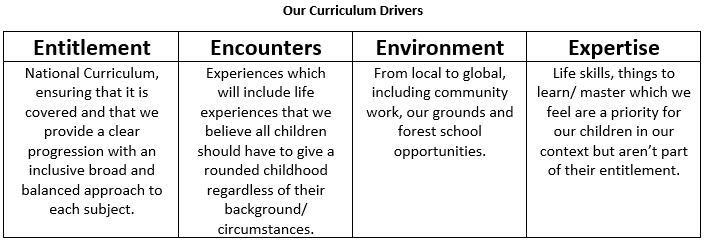
We wanted a curriculum which prepared our children for a changing world whilst respecting and learning from the place we live. An ambitious, inclusive and creative curriculum which develops outward looking pupils who are able to engage in learning about themselves and have an understanding of the wider world and its complex cultures.
We engaged with our current children, parents, staff and governors and also some of our past pupils who gave us some key feedback about their perception of what would improve our school curriculum. “It would be good to do other subjects like DT, Geography & Science.” When we gave examples of learning they had experienced in those areas the overwhelming response was- “No- that was topic.”
So we decided that our learning was to return to being subject driven, developing historians, designers and scientists. Teaching subject based skills and knowledge with themes (Victorians etc) as a vehicle to learn and ensuring that we prepare them well to continue their learning in KS3.
We then attended some training with Chris Quigley around ‘Making Learning Stick’ and ‘Assessment without Levels.’ His ‘Essentials Curriculum’ allowed us a sound starting point to our curriculum which whilst maintaining a consistent approach, we continue to review and change to meet the ever-changing needs of our children, effective resourcing to support our teachers and in response to CPD.
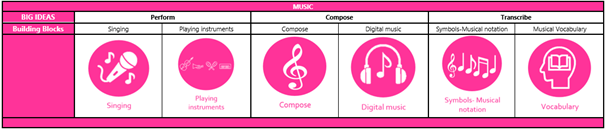
Our cyclical curriculum ensures that subject, ‘Big Ideas’ and ‘Building Blocks’ are revisited throughout their education with us, providing a firm foundation upon which to hang their learning. Each time they meet the ‘Big Ideas/ Building blocks’ via different themes, it allows the learning to stick as it creates a change in long term memory. Breadth of study is more important for procedural/ semantic learning. Using the procedural information to connect with semantic ‘facts’ in order to make connections and build efficient schemas by revisiting and building upon previous learning. Knowing more and remembering more. Vocabulary is a key building block for long term learning. It is a Building Block for every subject taught.
Implementation
We believe that the whole school need to understand how areas develop through the school and therefore our staff team will be divided into 3 Curriculum Groups. A governor will sit over all three to hold an ‘overview’ with the headteacher and a governor will work with each curriculum group to shadow, challenge and support the development of the areas.
Curriculum groups ensure that we are working together as a school not as class islands. There is a shared understanding of the curriculum but also other key areas, for example the development of our new attendance and behaviour policy. They will spend time looking at books and conducting pupil interviews as gap tasks and then feeding back.
Teachers take the lead in subject areas but have the support of another teacher to ensure consistency of approach. We have three-year cycle of Curriculum ‘Evaluate- Develop- Consolidate’ in order to prioritise key school development priorities and CPD.
Timetabling is constantly reviewed and has led to Science being on Friday mornings (in most classes) in order to raise its profile as a core subjects and protect its curriculum time. We have also developed the quality of our PSHE curriculum by using it as a ‘soft landing’ after a holiday by teaching it as a block on our return. This learning can then be revisited incidentally throughout the half term.
When planning, the teacher plans for the whole class and makes changes to the curriculum or resources so that all learners can achieve the same goals.
Impact
Assessment
- Assessments which are accurate and effective are the cornerstone of learning. ‘Assessment for learning’ is at the heart of our practice. In essence this means quality first teaching where staff know exactly what children can do and where to take their learning next.
- Adaptive teaching is an approach whereby the teacher will continually assess the strengths and needs of learners and adapt their teaching accordingly to ensure all learners can meet expectations. Technology may play a part in both assessment and subsequent personalisation of the teaching, but it is not essential.
- Children having a sound understanding of their own learning, knowing how well they are doing and how to improve is in integral part of this.
- Assessment at the point of teaching in the form of a test or task, does not evidence long term learning.
How is this achieved?
- Through effective questioning to assess what children know. When we talk about knowledge we mean connected knowledge towards a subject ‘Big Ideas’ not a list of facts to be regurgitated in just one way.
- Through specific marking and feedback which children understand and act upon
- Through praise which is made specific to the learning observed
- Through clear understanding of the intended learning
- Through opportunities to celebrate progress, resilience and achievements
- Through ‘assessment for learning’ where staff respond to children’s learning on a lesson by lesson basis
- Through robust discussion, in school, of each child’s progress through a meeting every 60 days
- Through careful analysis of group and cohort attainment and progress by all staff
- Through an understanding of progression through the school in that subject area.
How is this shared with parents?
- Termly parent meetings or reports
- Curriculum termly plans and regular updates on the school newsletter
- Twitter feed
How are governors’ enabled to make judgements?
- Through linking with curriculum groups and being involved in the development and monitoring of the curriculum
- Through rigorous analysis of data on termly Headteacher reports
- Subject leaders use assessment data triangulated with book scrutinies, learning walks, moderation, teacher and pupil feedback to make a clear plan of action and identified CPD needs or key areas of the curriculum to be reviewed.
New Curriculum Maps are added to the class pages throughout the year and sent home.
For more information about our approach to learning, please click on the subjects for more information.
GoodrichChurch of England Primary School
Contact Us
Goodrich, Ross-on-Wye, Herefordshire, HR9 6HY