Diocese of Hereford Multi-Academy Trust
Our Family of Academies

Our Family of Academies

GoodrichChurch of England Primary School

Mental Health & Wellbeing
WHAT IS MENTAL HEALTH?
We all have mental health, like we all have physical health. It’s important we take care of both as they are part of our overall wellbeing. When someone experiences a mental health problem, it can affect their thinking, their mood, and their ability to relate to others as they usually would.
Mental health problems are common, with 1 in 4 people affected in any year. It’s 1 in 10 young people, or 3 young people in the average classroom suffer from a diagnosable mental health problem, more accurate figures on the recent prevalence of mental health problems in young people do not exist. It is estimated that the figures are actually a lot higher.
The reasons for the rise in the number of children and young people experiencing mental health problems are varied. Nevertheless, young people these days face increased pressures to when we were younger. This relates to increased academic pressures but also pressures to look and act a certain way given the advent of social media. An increase in bullying and the number of children living in poverty have also been found to contribute to the rise in children and young people’s mental health problems.
With the right help and support most young people will recover from their mental health difficulty. Young people have a much better chance of recovery if their problems are identified early. This is why it is important for you to be aware of common signs and symptoms to be aware of and which may suggest that a young person is suffering.
Mental health difficulties are rarely caused by one single thing and there are many factors that can impact on mental health.
It is helpful to encourage a child or young person to see their mental health problem as just a difficult period in their life which they can get better from. Some children even manage to overcome their mental health problem with just a little help and guidance and without receiving any specialist support. It is important not to dismiss or play down a child’s mental health problem as this may make them think you don’t care or see their problems as insignificant.
It can be difficult working with a child or young person who is experiencing a mental health problem. It is therefore essential to look after your own health and wellbeing. You cannot be there to help and support a child or young person if you are not feeling well yourself.
LOOKING AFTER YOUR OWN MENTAL HEALTH
Parenting or caring for a child or young person can be tough. It’s important to make sure you look after your own mental wellbeing, as this will help you support yourself and those you care about.
LINKS TO SUPPORT WEBSITES
The following organisations offer information and support on mental health and wellbeing:
-
- CAMHS (Child & Adolescent Mental Health Services)
- Every Mind Matters
- Young Minds
- 16 years +? Get support for your mental health
- Place2Be
- MindEd
- Child Bereavement UK and the Childhood Bereavement Network
- Youth Sport Trust and Sport England
- WISH- Wellbeing Information and Signposting for Herefordshire WISH is Herefordshire's free online wellbeing information and signposting service and covers a vast range of areas, including keeping yourself well, healthy lifestyles, disabilities, money and budgeting, housing and looking after someone.
- Change4Life - Change4Life motivates and supports children and families to make and sustain changes that will improve their overall health. They offer advice and ideas on healthy food and sugar swaps, tasty recipes and fun activities to help children stay healthy. You can also download their free Food scanner app, to find out what's really inside your food and drink.
- Ross-on-Wye Community Food Larder- If you need food assistance then you need to contact one of the agencies or individuals listed on the site.
- Free School Meals- All primary school children in Reception year, Year 1 and Year 2 in Herefordshire are entitled to school meals. Free school meals are available to children in other year groups if you or your partner receive benefits. If you receive benefits and your child is in Reception year, Year 1 or Year 2, please complete a free school meals application form, as the school can get extra funding if you do. You only need to complete one application form for all your children, even if they attend different schools within Herefordshire.
- Emergency Welfare Support for Herefordshire residents in an emergency. This is called the local welfare provision scheme.
- Herefordshire Council Benefits Links to Herefordshire Council Benefits and Support
HERE ARE SOME GUIDANCE DOCUMENTS THAT ARE AVAILABLE TO DOWNLOAD.
- PREVENT Guidance for Parents
- Domestic Abuse - Advice for Parents
- Bereavement Guidance for Parents
- Young Carers
PARENTING GROUPS - HEREFORDSHIRE COUNCIL
AT GOODRICH- LEAD STAFF
- Our qualified Lead Mental Health Professional is Mrs Miles
- Our SENDCo is Mrs Taylor
- Our ELSA is Mrs Daniels
If you would like to speak to Mrs Miles, Mrs Taylor or Mrs Daniels or another member of staff about any of these issues, please pop into the office and make an appointment, or ring us on 01600 890422
SUPPORT AT GOODRICH
ELSA
An ELSA (Emotional Literacy Support Assistant) is a member of staff who is trained to support children in the development of their emotional literacy.
What is emotional literacy?
Understanding and coping with the feelings about ourselves and others.
Developing high self-esteem.
Being emotionally literate helps children focus better on their learning.
Some areas the ELSA may work on:
Recognising emotions.
Self-esteem.
Social skills.
Friendship skills.
Anger management.
Loss and bereavement.
How does the ELSA work?
A regular slot during the school week for 30-45 minutes.
A session can be individual or in small groups and tailored to the child’s individual needs.
Sessions are fun and might include role-play, puppets, board games, art and craft and stories.
They include time to talk.
A pupil’s progress will be reviewed on a half-termly basis.
As a parent/carer, how can you help?
By informing the class teacher if there are any issues that may be affecting your child.
Please feel welcome to contact your child’s teacher or the ELSA if you have any questions.
WELLBEING & EMOTIONAL SUPPORT TEAMS (WEST)
What is an Education Mental Health Practitioner
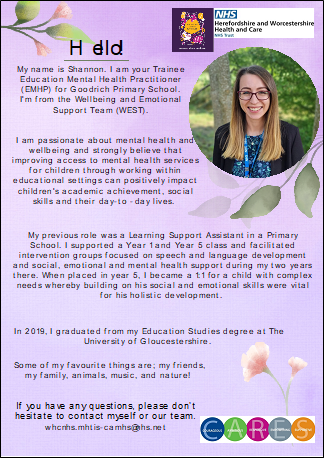
Education Mental Health Practitioners (EMHPs) work in schools and colleges to provide mental health support for children and young people (CYP), bringing together health and education.
Wellbeing & Emotional Support Teams (WEST)
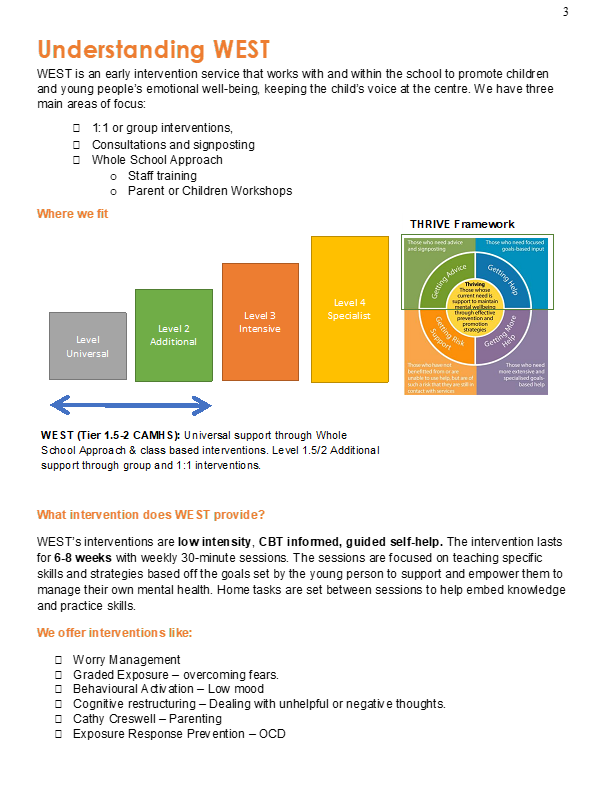
WEST are part of the government’s plan for schools to provide early mental health support to children and young people. Working together with staff, pupils and parent/carers to support emotional health and wellbeing throughout the school.
What is an EMHP?
Working within the WEST team, Education Mental Health Practitioners (EMHPs) are trained to assess and support children aged 5-18 years with:
- Low mood
- Worry
- Anxiety
- Panic
- Sleep difficulties
1:1 and group work
- The team deliver one to one sessions in school with children, young people and parents/carers.
- They provide low intensity interventions that have been proven to work, which take place over 6-8 sessions lasting 30 minutes each. These are based on cognitive behaviour therapy (CBT) and guided self-help.
- Tasks may be set for children and young people to complete in between sessions. This helps to put into practice what has been discussed in sessions.
What happens next?
With your consent, your child’s school will make a referral to WEST. An EMHP will then contact you to arrange an assessment session with you and/or your child. Sessions maybe online due to COVID-19.
The assessment will take approximately 45 minutes.
GoodrichChurch of England Primary School
Contact Us
Goodrich, Ross-on-Wye, Herefordshire, HR9 6HY